
Assessments with a second pair of eyes
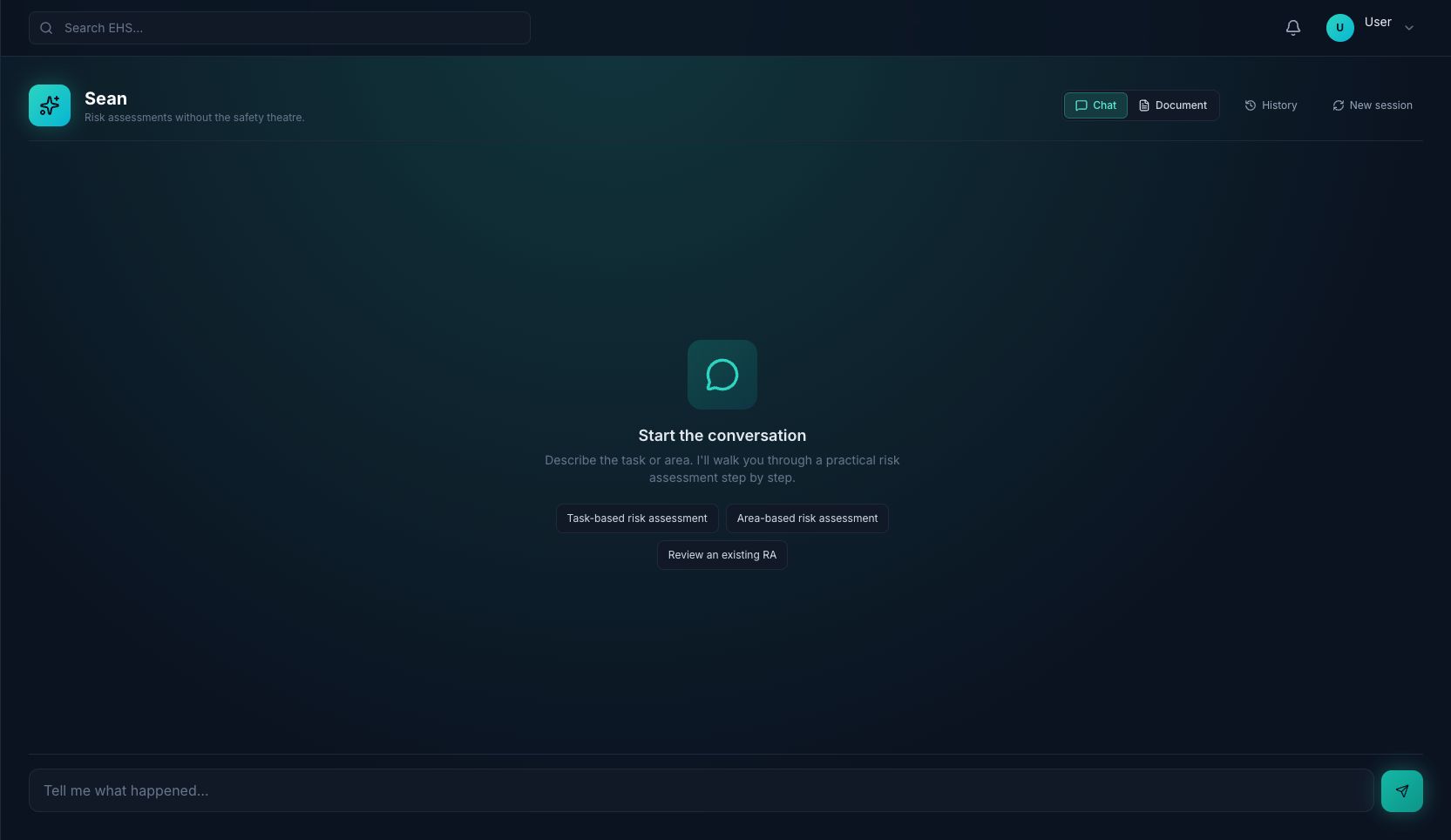
Work through the task, hazards and controls with support that asks the questions an EHS Manager would.
Built for manufacturing
The AI EHS system that does the work with you. Risks assessed, incidents investigated, actions kept moving, and everyone on site owning their part, with a Chartered practitioner’s judgement in every step.
Designed by Jonathan Wensley CMIOSH, PISEP, REnvP In EHS since 2007. Still on the floor.
Start with a conversation. Your AI-native EHS team takes it from there.
Done. The incident is created and open:
Worth flagging while it’s fresh: the injured person going home may need recording as a lost-time injury. A reversing truck striking a pedestrian is a segregation issue.
I’d hand this to Jess for the Level 1 investigation. Shall I bring her in now?
Jess here. Let me get the key facts down while people are still on shift and memories are fresh.
How are they now? Weight-bearing? Were they advised to get it looked at?
Who was driving? Powered or manual? Trained, authorised, still on site?
Any witnesses? Segregation, mirrors, a blind corner? Was the reversing alarm working?
Earlier today an operative was struck on the foot by a powered pallet truck reversing out of aisle 3. It could easily have been worse.
A blind corner at the exit. No mirror, no segregation. It’s noisy, so the reversing alarm can be hard to hear.
Martin here. I’ve got the context from UNK-INC-260010. Here’s a short brief for the Despatch team, focused on aisle 3 until permanent controls are in.
Want a separate version for supervisors to read out at handover?
Before I draft the review: is the blind corner unique to aisle 3, or are other aisles the same layout? That decides whether the fix is one corner or a Despatch-wide segregation scheme.
Pedestrians and powered trucks share space in Dispatch without effective segregation. An August near miss has now escalated to an injury at the aisle 3 blind corner.
The response so far has relied on retraining, the weakest tier of the hierarchy of control. It has already failed.
The August action to retrain the dispatch team is still awaiting verification. The interim control for aisle 3 was only raised today.
Authorise physical segregation at aisle 3 and a Dispatch-wide review, or keep managing it behaviourally?
Recommendation: fund physical segregation and a traffic management plan, with training as backup rather than the primary control.
How it's built
Most EHS systems store records and leave the site EHS team to feed them. EHS Manager is different twice over. It was built the other way round, taking the admin off the EHS team so the work moves with the people who own it. And it’s been AI from day one, not bolted on.
Your data stays yours: customer data is never used to train AI models.
One connected system
A risk assessment creates further controls. An investigation creates actions. Your team needs a briefing, and leadership needs to know what’s changed. EHS Manager keeps that work connected, with specialist support at each step.
Risk
Build risk assessments through conversation and review contractor RAMS against the real job. Challenge weak controls, identify what’s missing and turn the next steps into owned actions.
Explore Risk →You said “operators are told to be careful.” That’s not a control – it’s hope with a briefing.
Is the machine isolated before they reach in? Guarding that stops it? What’s actually in place right now?
Right – so existing controls are an e-stop and a fixed guard with a gap. No isolation, no SOP. That’s the reality.
Scored as it stands: likelihood 4 × severity 4 = 16, high. Sound about right, or do you want to adjust L or S?
| Business name | Location | Assessor(s) | Signature(s) | Review date |
|---|---|---|---|---|
| Acme Foods Ltd | Plant A | Sarah Mitchell | Sarah Mitchell | 23 Sep 2027 |
| No. | Hazard | Existing controls | L | S | R | Further controls required | L | S | R |
|---|---|---|---|---|---|---|---|---|---|
| 1 | Mechanical traps – nip points, in-running rollers, conveyors | Fixed perspex guarding; interlocked doors; light curtain on infeed transfer; e-stops… | 4 | 4 | 16 | 1.1 Engineering: extended fixed or tunnel guard over the infeed transfer gap (BS EN ISO 13857) 1.2 Engineering: interlocked jam-clear hatch at the flap folder 1.3 ‘Stop – Open – Clear’ procedure with personal padlock isolation | 2 | 4 | 8 |
| 2 | Hot melt glue – burns | Melter lid; gauntlets and glasses… | 4 | 3 | 12 | 2.1 Pressure relief before any nozzle or hose work… | 2 | 3 | 6 |
| # | Action ref | Further control | By whom | By when | Status |
|---|---|---|---|---|---|
| 1.1 | ACT-260021 | Fit extended fixed guard or tunnel guard over the infeed transfer gap | Engineering Manager | 26 Sep 2026 | Open |
| 1.2 | ACT-260022 | Add a jam-clear hatch with interlock at the flap folding section | Engineering Manager | 26 Sep 2026 | Open |
| 1.3 | ACT-260023 | Introduce a ‘Stop – Open – Clear’ procedure with personal padlock isolation | Production Manager | 26 Sep 2026 | Open |
| 1.4 | ACT-260024 | Change the PSC so interlocks and e-stops are physically tested and recorded | Production Manager | 30 Sep 2026 | Open |
| 2.1 | ACT-260027 | Pressure relief before any nozzle or hose work | Engineering Manager | 26 Sep 2026 | Open |
Work through the task, hazards and controls with support that asks the questions an EHS Manager would.
Keep the assessment live, bring it back for review and track further controls in one Action Plan.
Incidents
Capture what happened, work through the investigation and turn findings into actions. Keep the evidence and the follow-up together, so the investigation can keep moving.
Explore Incidents →Minor, clear cause. Short summary and a corrective action.
Learning value, facts not fully clear. Witness accounts and basic cause analysis.
Serious or possibly reportable. Timeline, underlying and systemic causes.
Report what happened. I’ll help triage, gather witness statements, and build the investigation.

Actions
Further controls, investigation findings and RAMS review actions all come together. Each action has an owner and a date, with its progress visible in the same place.
Explore Actions →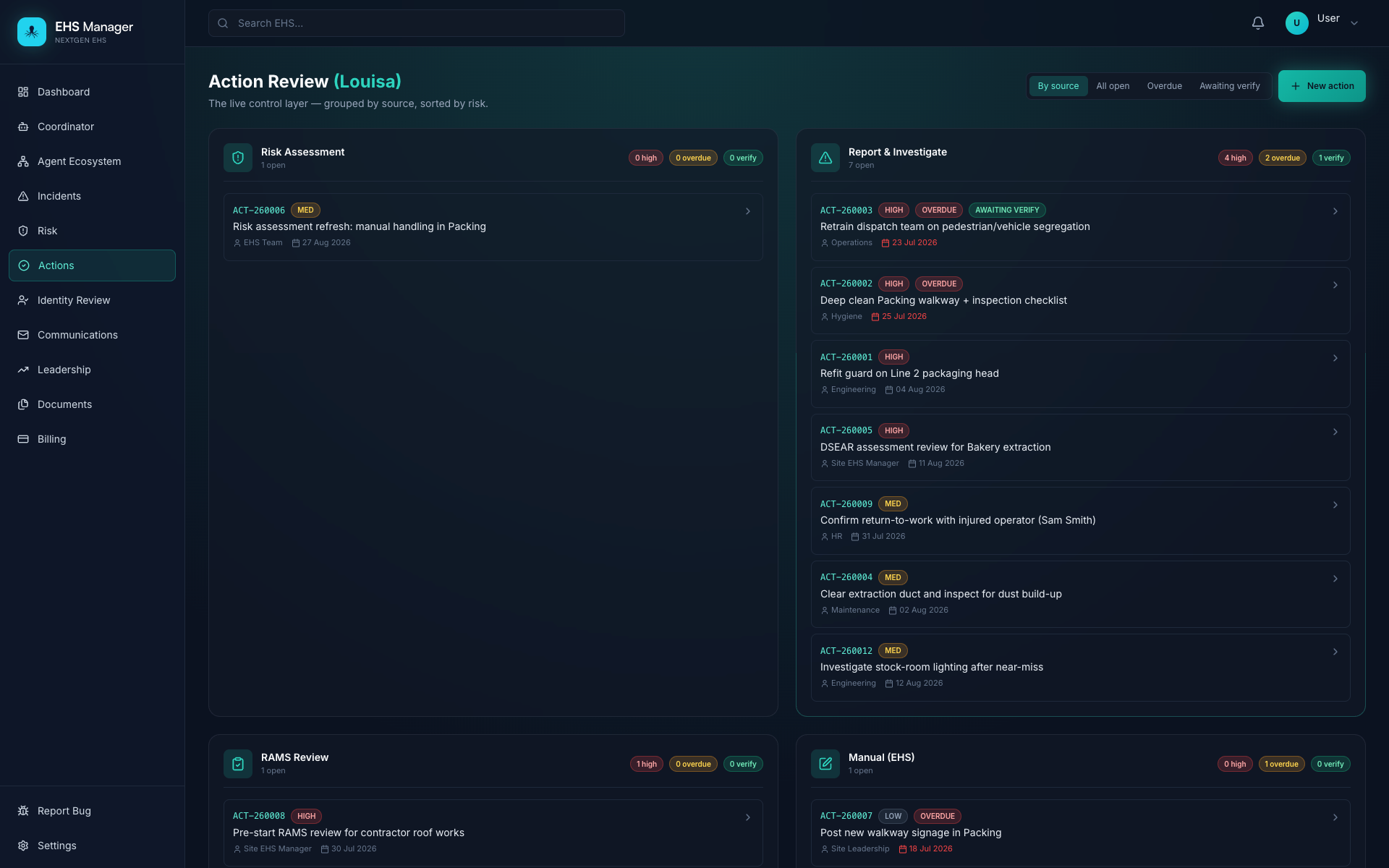 E
Communications
Bring findings and actions into clear briefings for the people doing the work. Keep communications connected to the issue that prompted them.
Explore Communications →Hi Kev,
After last Tuesday’s injury at aisle 3, please run the attached ten-minute toolbox talk at the start of every shift this week, days and nights.
The interim barrier at the aisle end is ACT-260063, due Wednesday. Until it’s in, please stand someone at the corner during peak loading.
Record who attends in EHS Manager so we can see who’s missed it.
Thanks,
Sarah
| Name | Role | Shift | Signed |
|---|---|---|---|
| Lee Ward | Picker | Days | Not yet |
| Dan Hughes | PPT driver | Days | Not yet |
| Amy Clarke | Picker | Days | Not yet |
| Tom Reid | PPT driver | Days | Not yet |
| + 7 more | Days | Not yet | |
| Mo Khan, Jo Price, Ravi Shah | Pickers | Nights | Not yet |
| Type | Title | Topic / recipient | Created |
|---|---|---|---|
| Briefing | Pallet trucks and people at aisle endsFrom UNK-INC-260010 · 11 of 14 briefed | Despatch pickers and PPT drivers | 06 Oct 2026 |
| Aisle 3 pallet trucks: brief every shiftFrom UNK-INC-260010 | Kev Rowe, Despatch Supervisor | 06 Oct 2026 | |
| Briefing | Line 2 jam clearing: stop, isolate, then clear | Guards stay on; isolate before reaching in | 30 Sep 2026 |
| Briefing | Oil spills in the walkway: spot it, report it, clean it | Packing walkways | 14 Sep 2026 |
| Briefing | Guards back on before the line runs | Line 2 | 07 Sep 2026 |

Leadership
Give leadership a view of the work across the site. Bring progress, outstanding actions and the issues that need attention into the same conversation.
Explore Leadership →Fund engineered segregation at aisle 3 and a Despatch-wide traffic management review, or keep managing this through behaviour?
 E
Dashboard
Open the system and the day is already sorted: what’s overdue, what’s escalating, where pressure is building and which issues keep coming back.
Explore Dashboard →People take ownership of EHS work and follow it through.
11 qualifying conversationsControls are connected to the risk, not treated as rules.
10 qualifying conversationsHazards and weak controls are found without prompting.
8 qualifying conversationsNot enough evidence for this selection.
Shown when the conversations support itConcerns are discussed openly and information volunteered.
16 qualifying conversationsNot enough evidence for this selection.
Shown when the conversations support itNo return-to-work update logged in the last 7 days. Confirm status with HR or the injured person.
They’re concentrated in one department. A short briefing could unblock the team.
It has been at Level 3 for 45 days. Review progress.
 E
Live counts and action pressure sit alongside six Insights scores taken from how people talk about the work.
The Coordinator spots what's slipping and prepares the next step. You approve it.
Bring the questions from your site. We'll show you how EHS Manager connects the assessment, the investigation and the action that follows.